

"Use Your Mind, Not Your Back"
My father's final advice carried a refinery-town kid from a tiny, humble Texas library to the heart of Silicon Valley

It’s been almost two years since Cisco laid me off- my role, like so many, absorbed into the company’s pivot into AI. That didn’t just end a long tech career. It ended a lifelong romance with intelligence - the thing my father told me would save me, the thing I’d chased from a Gulf Coast library to Silicon Valley because I believed it would set me free. The illusion had been cracking for years. I just refused to look. Now I can see the whole arc - and where it’s taking the rest of us as we roll into the AI era.
The romance started, unwittingly, when I learned to read. On long, steamy Texas summer days, my mother would haul me to the little library in our hometown of Port Neches, ninety miles from Houston- and a stone’s throw from Port Arthur, home of one of the world’s largest post-war concentration of refineries and petrochemical plants. It wasn’t much - a low brick building that smelled of floor wax and old paper - but to me it was where magic happened, where new worlds opened.
I needed them. My father had just died, at thirty-eight, of cancer. I was eight, starting third grade. Comic books first, then real ones, nonfiction, science fiction. I read as if my life depended on it, and maybe it did. When my teacher ran a spring reading contest, I won easily - a dozen or so books off her list.
I didn’t understand the rest of it until much later: the advice my father gave
me from his hospital bed in Houston. Get educated. Get a degree. Use your brain instead of your back. That search would carry me through college, fourteen years in journalism, and three decades in Big Tech - Intel, HP, Cisco - companies that would remake the world.
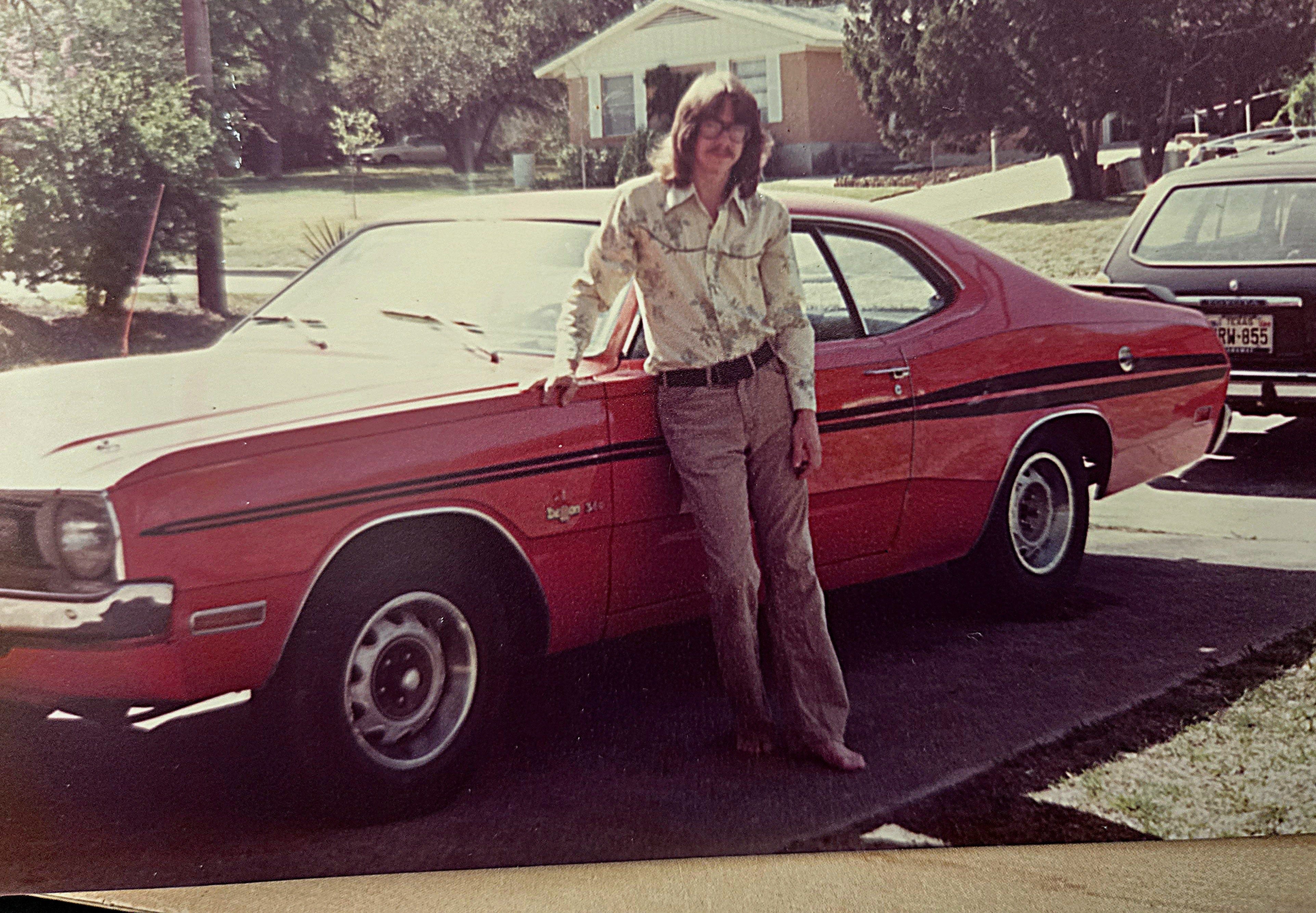
By the time I packed up my flaming, reddish-orange 71 Dodge Demon, long hair and all, and drove to Austin and the University of Texas, I was sure of it: education, knowledge, intelligence - that was my ticket out of the refinery lands. And I was right. Austin was a liberal oasis then, firebrand writers like Molly Ivins and Jim Hightower lashing out at Texas politicians in the Texas Observer, a liberal city council, the Vietnam War winding down but still the topic of raging discussions. I was in heaven, surrounded by smart people, new ideas, arguments worth having.
Jump ahead a few years. I was BusinessWeek‘s bureau chief in Houston, covering the oil industry, when I got handed two small, emerging companies: Dell and Compaq. IBM had launched the personal computer, and the clones were racing to cash in. I didn’t know it yet, but I’d just been handed the future.
1980s. The world was starting to go digital, and that would change everything. I’d grown up analog - a black rotary Ma Bell phone on the wall, a radio, one TV with 3 channels. I can still see my mother at the kitchen bar, smoking her Kent cigarettes, country music playing, waiting for the phone to ring or a neighbor to stop by for coffee. Like every kid I knew, I spent my days outside, running around, riding bikes, playing baseball and swimming in local ponds. Time moved slowly in SE Texas. Now I was walking into a world where a person with a PC and a modem could soon reach anyone, anywhere, in an instant.
Compaq called its first machine a “luggable.” It was more like a portable sewing machine, but when the company let me take one home, I stayed up the whole night, mesmerized by that tiny green screen. A word processor. A spreadsheet. A couple of primitive games. I was hooked.
The brains of that machine was an Intel 8088 - the chip inside the IBM PC and its clones, the one that pushed computing into the mainstream. And the timing wasn’t lost on me. One afternoon I looked out my twenty-fifth-floor window across downtown Houston. Traffic was thin. Three giant cranes stood frozen beside half-finished skyscrapers - “see-through buildings,” people called them, because you could look straight through the glass of floors that would sit empty for years. Oil was collapsing. The industry was shedding hundreds of thousands of jobs. The old economy - my father’s economy, the one that ran on oil and muscle - was hollowing out in real time, right in front of me. And now in front of me sat the thing that would replace it: a machine that ran on intelligence.
Out west, Intel was rising, and the more I dug, the more its story pulled me in. It began in 1957, when Robert Noyce walked out on William Shockley - a brilliant inventor of the transistor but a tyrannical manager - taking seven others, including Gordon Moore, to found Fairchild Semiconductor. There, Noyce co-invented the integrated circuit, which let engineers etch an entire circuit onto a single sliver of silicon - the thing that made everything after it possible. Eleven years later, he and Moore left to found Intel.
It was at Intel that the microprocessor was born - an entire computer’s brain on a single chip - the invention that would drive the PC revolution and more. Noyce and Moore became my new prophets.
To Noyce a chip was a path to drive more innovation-to unleash more people to invent- start companies, and build, intelligence unleashed across a whole economy. Truth is, he wasn’t a great manager - more of a visionary, inventor, a big-picture, flamboyant genius. He ran his companies to match: no reserved parking, no corner offices, first names all around, a plain faith from his Midwest roots that smart people set loose would remake the world. The day-to-day he left to Andy Grove, a brilliant Hungarian refugee who went on to transform Intel into one of most powerful companies on the globe. He ran Intel by a very different creed. I'd learn it soon enough.
Gordon Moore was the quieter prophet. In 1965 he predicted that the number of components crammed onto a chip would keep doubling, year after year - and he didn’t stop at the engineering. He saw where it led: cheap, ever-multiplying computing power seeping into everything - research, communications, ordinary life. What became known as “Moore’s Law” turned into a guiding roadmap for the tech industry that held for decades: intelligence would keep getting cheaper and more abundant, forever. To a kid who’d read his way out of the refinery corridor, that was scripture.
That was the gospel I fell for, and the vision behind it. Noyce and Moore weren’t just selling chips. They were selling the same thing my father had promised from his hospital bed, only scaled to the whole world. Use your mind, not your back. Intel and the rising tech companies were hotbeds of intelligence, unleashing minds to change the world. I was covering the future, and it ran on exactly what I’d been chasing since that little library in Port Neches.
Then, in the fall of 1991, an Intel recruiter called. They wanted me to write paid national editorials, under CEO Andy Grove’s name, in national pubs like Newsweek.
I didn’t think twice. I packed up the family and headed west - certain I was about to ride the revolution that would transform the world, and that the dream my father handed me was finally coming true.
Next, Andy Grove's Intel taught me what intelligence was really worth - a lesson that would take thirty years, and an AI revolution, to fully land.